
Car accidents, construction site injuries, and premises liability cases often involve more than one at-fault party. A multi-car pileup might involve three negligent drivers. A construction injury might involve a general contractor, a subcontractor, and an equipment manufacturer. When that happens, California law doesn’t simply let you collect the full judgment from whichever defendant is easiest to find a 1986 ballot measure called Proposition 51 changed how damages get divided among multiple defendants, and it’s one of the least understood rules in California personal injury law.
What Proposition 51 Did
In June 1986, California voters approved Proposition 51, the Fair Responsibility Act, by a wide margin about 62% to 38%, according to Ballotpedia’s summary of the election results. The measure was codified as California Civil Code § 1431.2, and it changed a long-standing rule called “joint and several liability” as it applies to one specific category of damages: non-economic damages.
Before Prop 51, if you were injured by multiple defendants, you could generally collect 100% of your total judgment including pain and suffering from any single defendant, regardless of that defendant’s individual share of fault. That defendant could then try to recover a contribution from the other at-fault parties, but the risk of a defendant being unable to pay fell on the other defendants, not on the injured plaintiff.
Prop 51 split damages into two categories and treats them differently:
- Economic damages (medical bills, lost wages, future care costs) remain joint and several. Any single defendant can still be held responsible for the full economic damages award, even if they were only partially at fault, leaving that defendant to seek reimbursement from co-defendants.
- Non-economic damages (pain and suffering, emotional distress, loss of enjoyment of life) are now several only. Each defendant is liable only for the percentage of non-economic damages that matches their own percentage of fault full stop.
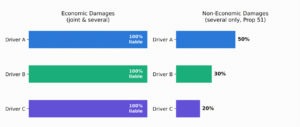
Illustration: how a 3-defendant claim splits economic vs. non-economic damages under Prop 51. (Original graphic created for this article.)
For a free legal consultation call (310) 424-7858
Why This Distinction Can Matter a Great Deal
Here’s where Prop 51 becomes a real practical problem rather than a legal technicality: if one of several at-fault defendants is uninsured, underinsured, bankrupt, or otherwise judgment-proof, the plaintiff, not the other defendants, absorbs the loss for that defendant’s share of non-economic damages.
A simplified example: three drivers are found liable for a crash that leaves you with $50,000 in medical bills and a jury-assessed $300,000 in pain and suffering. Fault is split 50/30/20. If the 20%-at-fault driver has no insurance and no meaningful assets, you can still collect your full $50,000 in medical bills from either of the other two drivers but you can only collect $150,000 (50%) and $90,000 (30%) of the non-economic damages from them respectively. The remaining $60,000 in pain-and-suffering damages tied to the uninsured driver’s share is likely uncollectible.
This is one of the main reasons an experienced attorney will investigate every potentially liable party in a multi-defendant case early, and will also look closely at each defendant’s insurance coverage and financial exposure not just whether they were at fault, but whether a judgment against them is actually collectible.
How This Plays Out in Common Case Types
Proposition 51’s several-liability rule comes up most often in:
- Multi-vehicle freeway pileups, where fault is split among several drivers with different insurance limits
- Construction site injuries, where a general contractor, subcontractor, and equipment supplier may all share fault
- Premises liability cases involving a property owner and a separate maintenance or security contractor
- Product liability claims where a manufacturer, distributor, and retailer are all named as defendants
- Claims involving a government entity as one of several defendants, since public entities are frequent Prop 51 defendants and the measure was partly driven by concerns about government liability exposure
Click to contact us today
What This Means for Your Strategy
Because several liability shifts collection risk onto the injured plaintiff, the practical response is usually to cast a wide net early: identifying every potentially responsible party, confirming each one’s available insurance coverage, and building the strongest possible case for the percentage of fault assigned to the parties who can actually pay. Settlement negotiations in multi-defendant cases are also more complex, since each defendant’s insurer is incentivized to argue that a co-defendant rather than their own insured bears most of the fault for non-economic damages specifically.
Complete a Free Case Evaluation form now
Bottom Line
Proposition 51 doesn’t reduce your total damages on paper, but it can significantly reduce what you actually collect when one of several at-fault parties can’t pay their share of pain-and-suffering damages. Understanding this rule before settlement negotiations begin, not after, is what allows an attorney to pursue the parties and insurance policies that actually make a judgment collectible.
If your injury involved more than one potentially at-fault party, Zadelaw offers free consultations to help identify every liable defendant, evaluate available insurance coverage, and build a strategy that accounts for how California’s several-liability rules affect your actual recovery. Contact Zadelaw today to discuss your case.
Call or text (310) 424-7858 or complete a Free Case Evaluation form