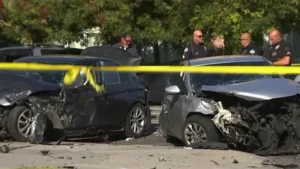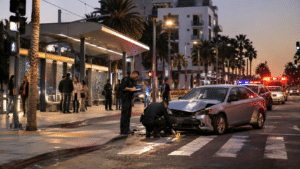
On the evening of November 10, 2026, a vehicle plowed into a crowd of pedestrians in the 5300 block of North Lankershim Boulevard, near a North Hollywood Metro station. Three women ages 40, 53, and 69 were pronounced dead at the scene, and at least two others were hospitalized in critical condition, according to ABC7 Los Angeles. The following day, the Los Angeles Police Department confirmed the driver, 61-year-old Ihor Demianenko, had been arrested on suspicion of felony DUI and was being held on more than $6 million bail, as ABC7 reported.
It’s an awful story, and unfortunately not a rare one. Drunk-driving crashes like this one raise a set of legal questions that are different from an ordinary fender-bender question about who can be sued, how fast the clock is running, and why the criminal case against the driver won’t, by itself, pay anyone’s medical bills. If you or someone you love has been hurt by a drunk driver anywhere in California, here’s what matters for your case.
Drunk Driving Is Still One of the Biggest Killers on California Roads
This isn’t an isolated tragedy. Nationally, about 32 people die every day in alcohol-impaired driving crashes, and in 2024 alone, 11,904 people were killed in drunk-driving crashes roughly 30% of all traffic deaths that year, according to NHTSA data. Pedestrians near transit stops, crosswalks, and dense commercial corridors exactly the kind of stretch of Lankershim Boulevard where this crash happened are especially vulnerable, because they have no metal or airbags between them and an impaired driver’s vehicle.
For a free legal consultation call (310) 424-7858
The Criminal Case and Your Civil Case Are Not the Same Thing
When a drunk driver is arrested, it’s natural to assume justice is already in motion. But a criminal prosecution even a felony DUI charge with multi-million-dollar bail is the state punishing the driver. It does not compensate victims for medical bills, lost income, funeral expenses, or pain and suffering, and it does not automatically pay a family’s wrongful death damages. That only happens through a separate civil claim or lawsuit, which victims and surviving family members (or their estates) must pursue on their own, typically with their own attorney, independent of whatever the district attorney does.
A felony conviction can still help the civil case it can serve as strong evidence of fault and sometimes supports a claim for punitive damages but it is not a substitute for filing one.
Who Can Actually Be Held Financially Responsible
In a pedestrian-involved DUI crash, more than one party can potentially be on the hook:
- The driver, for general and special damages tied to the crash itself.
- An employer, if the driver was on the job or using a company vehicle at the time (respondeat superior).
- A bar, restaurant, or event host, in narrow circumstances. California generally shields businesses from “dram shop” liability for serving alcohol to an adult who later causes harm (Civil Code § 1714(c)), with a significant exception when a licensed establishment serves alcohol to an obviously intoxicated minor (Business & Professions Code § 25602.1).
- A public entity, such as a city, county, or transit agency, if a dangerous condition of public property poor crosswalk design, inadequate lighting, missing bollards near a transit platform contributed to the severity of the crash. This is a real avenue in cases involving transit stops and busy boulevards, but it comes with its own strict rules (see below).
Click to contact us today
The Deadlines and Liability Rules That Can Make or Break a Claim
This is where cases like this one get complicated fast, and where missing a date can cost victims their entire claim.
- Two-year statute of limitations. Under California Code of Civil Procedure § 335.1, injured victims generally have two years from the date of the incident to file a personal injury lawsuit, and the same two-year window applies to wrongful death claims brought by surviving family members.
- A much shorter deadline if a government entity is involved. If a city, county, or transit agency like LA Metro is a potential defendant for example, because of how a crosswalk, sidewalk, or station area was designed or maintained the Government Claims Act requires a formal administrative claim to be filed with that public entity within just six months of the incident (Government Code § 911.2). Miss that window, and a claim against the public entity can be barred entirely, regardless of how much time is left on the general two-year clock.
- Pure comparative negligence. California doesn’t bar recovery just because an injured person was partly at fault. Under the state’s pure comparative negligence rule, a victim’s compensation is reduced by their own percentage of fault, but they can still recover damages even if they were, say, 40% responsible.
- Proposition 51 and “several liability.” When more than one defendant is at fault (the driver and a bar, or the driver and a public entity, for instance), Civil Code § 1431.2 generally makes each defendant responsible for their own share of non-economic damages (like pain and suffering) rather than all of it jointly which is exactly why identifying every potentially liable party early matters.
Complete a Free Case Evaluation form now
If You or a Loved One Is Hurt by a Drunk Driver, Do This Right Away
- Get medical attention immediately, even if injuries seem minor some trauma symptoms don’t show up for days, and a documented medical record ties your injuries to the crash.
- Request the police report and any available traffic or transit-station camera footage before it’s deleted or overwritten.
- Collect witness contact information at the scene if you’re physically able or ask a family member or friend to do it.
- Check your own auto policy for uninsured/underinsured motorist (UM/UIM) coverage. DUI drivers are frequently uninsured, underinsured, or facing bail and legal fees that leave little left for victims UM/UIM coverage is often the real source of recovery in these cases.
- Note the exact location and any visible road, lighting, or signage conditions, in case a public entity’s property played a role.
- Talk to an attorney before the six-month public-entity deadline, even if you’re not yet sure whether a government claim applies that determination is often better made early than too late.
What Not to Do
Don’t give a recorded statement to any insurance company including your own before speaking with an attorney; insurers routinely use early statements to minimize payouts. Don’t accept a fast settlement offer, since injuries from high-impact pedestrian crashes often cost far more to treat than they first appear to. And don’t assume that because the driver is in jail facing serious charges, your own compensation is being handled it isn’t, until a civil claim is filed.
If This Happened to You
Our thoughts are with everyone affected by Tuesday’s crash in North Hollywood. If you or a family member has been injured or a loved one killed by a drunk driver anywhere in California, Zade-Law, APC offers free consultations to help you understand your rights, identify every potentially responsible party, and make sure no deadline gets missed. Reach out to our team to talk through your situation at no cost.
Call or text (310) 424-7858 or complete a Free Case Evaluation form