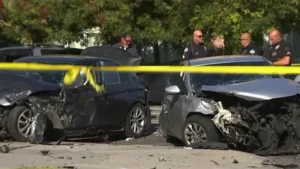
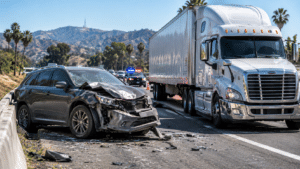
A California investigation published this month found something that should alarm every driver on the road: commercial truckers who had already been convicted of killing someone behind the wheel were, in many cases, allowed to keep their licenses and keep driving. According to reporting from CalMatters, nearly half of all commercial drivers charged with vehicular manslaughter over a recent five-year period still held a valid license afterward. The California DMV, which has the legal authority to investigate and suspend the licenses of drivers involved in fatal or serious-injury collisions, “routinely does nothing,” the investigation found.
The human cost of that inaction is not abstract. As KQED reported, a driver named Baljit Singh struck and killed a 26-year-old motorcyclist with his semitruck. His commercial license was not suspended. Eleven months later, Singh’s rig loaded with fertilizer and traveling 65 mph into slowed traffic outside Fresno crashed into an SUV carrying Jenny Chow and her teenage son, who were driving home from a college visit. Jenny Chow was killed. Her husband, Loren, later had to fight the DMV again this time over a late vehicle registration fee on the totaled car. “If the California Department of Motor Vehicles had done its job, Jenny Chow would still be alive,” the reporting states.
If you or someone you love has been hurt by a commercial truck in California, this story matters to your case because it shows exactly how these crashes happen, and it points to who can be held accountable.
Why California’s Safety Laws Didn’t Stop This
California already has rules on the books that are supposed to catch dangerous commercial drivers before they cause another tragedy. The gap isn’t in the law itself it’s in how inconsistently that law gets enforced. As a GV Wire op-ed by a California personal injury attorney lays out, the breakdowns include:
- Vehicle Code § 1804 requires courts to note on a conviction record whether the vehicle involved was a commercial truck but that box is often left unchecked or miscoded, so the DMV’s system never flags the driver as a commercial threat.
- Vehicle Code § 15300 can impose a one-year commercial driving disqualification after a fatal vehicular manslaughter conviction, and 15302 allows a lifetime ban after a second one but only if the conviction is properly reported in the first place.
- Vehicle Code § 1808.1 requires trucking companies to enroll Class A and B drivers in the DMV’s “pull-notice” program, which is supposed to flag new convictions to the employer at least every 12 months but the law only works if the employer acts on what it’s told.
- One California county court admitted to CalMatters that it had failed to properly report roughly two dozen vehicular manslaughter convictions, calling them simple clerical “errors.”
In other words, a trucking company and a driver can both be technically “in compliance” on paper while a documented killer is still behind the wheel of an 80,000-pound vehicle.
For a free legal consultation call (310) 424-7858
What To Do If You’re Hit by a Commercial Truck
Truck crash cases move fast, and the evidence that matters most can disappear within days. If you’ve been injured by a commercial truck in California, consider the following:
- Get medical care immediately, even if you feel “okay.” Soft-tissue, spinal, and head injuries from truck collisions often don’t show symptoms right away, and a documented diagnosis close to the crash date matters for your claim.
- Call the California Highway Patrol or local police and make sure a formal collision report is generated this becomes a central piece of evidence.
- Do not give a recorded statement to the trucking company’s insurance adjuster before speaking with an attorney. Trucking insurers often have claims teams in contact with the carrier within hours of a crash.
- Try to identify the trucking company and driver, including the name on the truck’s door (the “DOT number” is usually visible) this is often different from the company that employs the driver.
- Preserve evidence fast. Trucks carry electronic logging device (ELD) data, GPS records, and sometimes dash-cam footage that trucking companies are only required to retain for a limited time. An attorney can send a formal preservation letter immediately.
- Ask whether the driver has a prior commercial driving history. Given what the CalMatters investigation uncovered, this is no longer a theoretical question it’s one a California injury attorney should be asking from day one.
Who Can Actually Be Held Responsible
A natural reaction after reading about DMV inaction is to want to sue the DMV directly. In practice, that’s usually a dead end: California’s Government Claims Act gives public agencies broad immunity for discretionary decisions like whether or how to investigate a license even when that discretion is exercised poorly. (If a claim against any government entity is ever viable, California law requires it to be filed within six months of the injury under the Government Claims Act far shorter than an ordinary injury deadline.)
The more realistic and often more powerful path is a claim against the trucking company itself, built on negligent hiring, negligent retention, or negligent entrustment. If a company knew or should have known that a driver had a disqualifying conviction and failed to act on pull-notice records it was legally required to review, that failure can support liability independent of simple driver negligence. These claims can also open the door to punitive damages in cases involving conscious disregard for public safety, which are not available in an ordinary negligence claim. Depending on the facts, claims may also reach the vehicle or parts manufacturer, which is why the Chow family’s pending lawsuit, as KQED reported, names “the trucking companies and vehicle manufacturers” in addition to the driver.
Click to contact us today
California’s Rules That Will Shape Your Claim
Whoever you ultimately pursue a claim against, several California-specific rules will apply:
- Two-year statute of limitations. Under Code of Civil Procedure § 335.1, you generally have two years from the date of injury to file a personal injury lawsuit in California. Miss it, and you likely lose the right to sue entirely.
- Pure comparative negligence. California allows you to recover damages even if you were partly at fault for the crash your recovery is simply reduced by your percentage of fault, rather than barred outright.
- Proposition 51’s “several liability.” When multiple defendants (say, a driver, a trucking company, and a manufacturer) share fault, each defendant is only responsible for its own share of non-economic damages (like pain and suffering), though all defendants remain jointly liable for economic damages like medical bills and lost wages.
These rules interact in complicated ways in multi-defendant trucking cases, which is exactly why they benefit from early, experienced legal evaluation rather than a quick settlement offer from an insurance adjuster.
Complete a Free Case Evaluation form now
The Bigger Picture
Stories like Jenny Chow’s are a reminder that a commercial truck crash is rarely just “an accident.” It can be the foreseeable result of a licensing system, a court’s paperwork, or a trucking company’s compliance program failing to do its job and when that’s true, the law gives injured people and families a way to hold the responsible parties accountable, not just the driver who happened to be behind the wheel that day.
If you or a family member has been seriously injured in a California truck accident, Zadelaw offers free consultations to help you understand your rights and options. Reach out to our team to talk through what happened and what you can do next.
Sources
- They killed with their big rigs. The DMV routinely did nothing — CalMatters (October 20, 2026)
- They Killed People With Their Big Rigs, and California Let Them Keep Driving — KQED (November 13, 2026)
- California Has Laws to Keep Killer Truckers Off the Road. Why Aren’t They Enforced? — GV Wire (November 17, 2026)
Disclaimer: This blog post is provided for general informational purposes only and does not constitute legal advice. It is not intended to create, and receipt of it does not constitute, an attorney-client relationship. Laws discussed here are subject to change, and the facts of every case are different — you should consult a licensed California attorney about your specific situation before taking any legal action. Reference to the news reporting above reflects publicly reported facts as of the dates cited and is not a legal determination of fault or liability by Zade-Law, APC as to any person, company, or driver named.
Call or text (310) 424-7858 or complete a Free Case Evaluation form