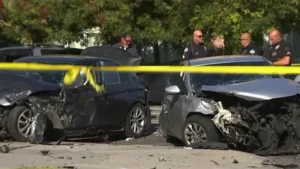
On the morning of November 12, 2026, a Los Angeles County Sheriff’s patrol SUV ended up on its side in Calabasas after a chain-reaction crash at Parkway Calabasas and Calabasas Road. According to ABC7 Los Angeles, investigators believe a driver ran a red light, striking the back of the deputy’s vehicle, which then spun into a third car before rolling onto its side. NBC Los Angeles reported that both the deputy and the driver who ran the light were hospitalized with non-life-threatening injuries, while a third driver was not hurt.
Nothing about this crash is unusual for a Thursday morning commute in the San Fernando Valley until you think about who else was on that road. A deputy’s patrol vehicle, owned and operated by the County of Los Angeles, was one of the vehicles involved. For the other drivers and any passengers caught up in that crash, that detail changes the entire legal clock they’re now running against, whether they realize it or not.
Most people who get hurt in a California car accident have heard, correctly, that they have two years to file a lawsuit. Far fewer know that when a city, county, state agency, or public employee acting within the scope of their job is involved, that two-year window effectively shrinks to six months and missing it can end your case before it starts.
Why a Crash Involving a Government Vehicle Is Different
California’s general rule for personal injury claims is set out in Code of Civil Procedure section 335.1: you generally have two years from the date of the injury to file a lawsuit. That’s the deadline most injured drivers plan around.
But when the person or entity you’d be suing is a public entity a county sheriff’s department, a city police department, a state agency, a school district, or a transit authority California’s Government Claims Act imposes a separate, much shorter requirement. Before you can sue a public entity (or, in many circumstances, its employee acting on the job) for a personal injury, you must first file a formal administrative claim with that government agency. That claim generally has to be submitted within six months of the incident, not two years.
If you miss that six-month window, the agency can reject your claim as untimely, and in most cases that forecloses your ability to sue altogether you don’t get to fall back on the standard two-year deadline. Courts can occasionally allow a late claim under narrow circumstances, but that relief is far from guaranteed and requires its own separate petition.
This is exactly the kind of deadline that catches accident victims off guard. In a multi-vehicle crash like the one in Calabasas, a driver might reasonably assume they have two years to sort out property damage, medical bills, and a possible claim not realizing that because a sheriff’s vehicle was part of the chain reaction, the clock against the County itself is running on a six-month fuse.
For a free legal consultation call (310) 424-7858
What To Do in the First 48 Hours
If you’re involved in a crash that includes a police vehicle, fire truck, city-owned car, or any other government vehicle, a few steps matter more than usual:
- Get the full incident report number and the responding agency’s name, not just “the deputy.” You’ll need this to identify exactly which government entity may be a proper party to a claim.
- Photograph everything at the scene vehicle positions, skid marks, traffic signal state if visible, and damage to all vehicles involved, not just your own.
- Seek medical evaluation immediately, even if you feel “just shaken up.” Documented treatment close in time to the crash is some of the strongest evidence connecting your injuries to the collision, and insurers for public entities scrutinize gaps in treatment closely.
- Avoid giving a recorded statement to any insurance adjuster public or private until you’ve spoken with an attorney. Early statements taken before you understand the full scope of your injuries can be used to minimize a later claim.
- Act well before six months have passed. Investigating a claim against a public entity, gathering records, and preparing a government claim form takes time; waiting until month five leaves little room for error.
Who Actually Pays When Multiple Drivers Share the Blame
Crashes like the one in Calabasas, with three vehicles and at least two drivers whose conduct is in question, raise a second issue that trips people up: how fault and compensation get divided when more than one party may be responsible.
California is a pure comparative negligence state. That means an injured person can still recover damages even if they were partly at fault for the crash their recovery is simply reduced by their own percentage of fault. A driver found 20% responsible for a collision can still recover 80% of their damages from the other parties involved.
Where it gets more complicated is when there are multiple at-fault defendants, as there appear to be in a chain-reaction crash. Under Proposition 51, codified at Civil Code section 1431.2, each defendant is only “jointly and severally” liable for the injured person’s economic damages (like medical bills and lost wages) as a group, but each defendant is liable for non-economic damages (like pain and suffering) only in proportion to their own share of fault. In practice, that means if one at-fault driver doesn’t have enough insurance to cover their share, you may not be able to collect that portion from a different, less-at-fault defendant another reason it matters to correctly identify and pursue every responsible party, public and private, from the start.
Click to contact us today
The Statistics Behind the Headline
Crashes involving multiple vehicles at signalized intersections are not a rare fluke of one bad Thursday morning. Red-light-running and intersection collisions remain one of the most persistent causes of serious injury crashes on California roads, and when a responding or patrol vehicle becomes a secondary party to a crash it didn’t initiate, it illustrates how quickly an ordinary commute can turn into a legal situation involving a public agency, a private driver, and overlapping insurance policies, each with its own rules and deadlines.
Complete a Free Case Evaluation form now
What To Do If You Weren’t the One Who Caused It
If you were the driver who was rear-ended or sideswiped through no fault of your own, and a government vehicle happened to be part of the resulting chain reaction, don’t assume your claim against the government side will proceed just like your claim against the private driver who ran the light. They won’t. You will likely be dealing with two entirely different processes on two entirely different timelines at the same time a standard insurance claim or lawsuit against the private driver, and a formal government claim, with its own form, its own six-month deadline, and its own agency to notify, against the public entity.
Sorting out who owes what, in what proportion, and on what schedule is exactly the kind of work an experienced personal injury attorney handles so you don’t have to figure it out while you’re still recovering.
If You’ve Been Hurt in a Crash Involving a Government Vehicle, Don’t Wait
Six months moves faster than it sounds, especially when you’re dealing with medical appointments, missed work, and insurance paperwork on top of everything else. If you or someone you love has been injured in a crash involving a police vehicle, a city or county vehicle, or any other government-owned car in California, reach out to Zade-Law, APC for a free consultation. We can help you identify every responsible party, meet every deadline including the ones most people never hear about and pursue the full compensation you’re entitled to.
Call or text (310) 424-7858 or complete a Free Case Evaluation form