

One of the first things insurance adjusters do after an accident is look for a way to blame the injured person. If they can pin even 20% or 30% of the fault on you, they’ll use it to justify a lower settlement offer and sometimes to deny the claim outright. Many injured people assume that if they share any blame at all, they’re out of luck. In California, that assumption is wrong, and believing it can cost you a real recovery.
California follows a rule called “pure comparative negligence,” and understanding how it actually works is one of the most important things you can do before negotiating with an insurance company.
What “Pure Comparative Negligence” Actually Means
California adopted pure comparative negligence through the landmark 1975 California Supreme Court decision in Li v. Yellow Cab Co., replacing the older, harsher rule of contributory negligence, which barred any recovery if the plaintiff was even 1% at fault.
Under pure comparative negligence, an injured person can recover damages even if they were mostly responsible for the accident up to 99% at fault as long as the defendant bears at least some share of the blame. Your total compensation is simply reduced by your own percentage of fault.
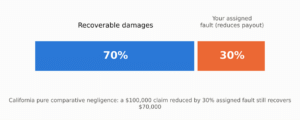
Illustration: a $100,000 claim reduced by 30% assigned fault still recovers $70,000. (Original graphic created for this article.)
For example: if a jury determines your damages are worth $100,000, but finds you were 30% at fault for the accident, your recoverable damages are reduced to $70,000. If you were found 80% at fault, you could still recover the remaining 20%, or $20,000.
This is very different from the law in many other states, which use a “modified comparative negligence” system that cuts off recovery entirely once a plaintiff’s fault reaches 50% or 51%. California has no such cutoff.
For a free legal consultation call (310) 424-7858
How Fault Percentages Actually Get Decided
Fault isn’t assigned by guesswork. In a lawsuit, a jury weighs the evidence and assigns a percentage of responsibility to each party involved, including the plaintiff, based on factors like:
- Traffic laws and right-of-way rules in effect at the time
- Physical evidence (skid marks, vehicle damage patterns, event data recorder/“black box” data)
- Witness statements and any available video footage
- Expert accident reconstruction testimony, in more serious or disputed cases
- Each party’s own conduct leading up to the incident (speed, distraction, signaling, etc.)
Before a case ever reaches a jury, insurance adjusters make their own informal fault assessments to decide how much to offer in settlement and they have a financial incentive to push your assigned share of fault as high as possible, since every percentage point directly reduces what they have to pay.
Why Insurance Companies Lean Hard on This Rule
Because comparative fault directly scales the payout, assigning blame to the injured party is one of the most common and effective tactics insurance companies use to minimize claims. Common examples include:
- Arguing a rear-ended driver “slammed on the brakes for no reason”
- Claiming a pedestrian was jaywalking or not in a marked crosswalk, even in cases where California law still gives pedestrians the right-of-way
- Pointing to a plaintiff’s speed being slightly over the limit, even when it didn’t cause the accident
- Suggesting a slip-and-fall victim “wasn’t watching where they were going,” regardless of a hazardous condition the property owner created
Adjusters often present an initial fault percentage as if it’s an objective, settled fact, when it’s really an opening negotiating position. Without pushback and without your own evidence that initial number can stick.
Click to contact us today
Why Evidence Matters More Than Ever Under This Rule
Because every percentage point of assigned fault comes directly out of your settlement, building a strong evidentiary record early is critical. Steps that can directly affect your fault percentage and therefore your final recovery include:
- Photographing the scene, vehicle damage, road conditions, and any hazards before they’re cleaned up or repaired
- Getting contact information for independent witnesses before they leave the scene
- Requesting preservation of surveillance or dash-cam footage immediately, since it’s often deleted or overwritten within days
- Seeking prompt medical treatment and following through on care, which undercuts arguments that your injuries were minor or unrelated
- Avoiding recorded statements to the other driver’s insurance company before you understand how fault will be analyzed
Complete a Free Case Evaluation form now
Comparative Negligence vs. Shared Liability Among Defendants
It’s worth noting that pure comparative negligence addresses how your own conduct affects your recovery. It’s a separate legal question from how liability is divided among multiple defendants when more than one party caused your injury. That scenario is governed by California Civil Code § 1431.2, enacted by Proposition 51, which makes defendants only “severely” liable for non-economic damages in proportion to their fault a rule that can further affect what you actually collect even after fault is assigned.
Bottom Line
Being told you were “partly at fault” is not the end of your claim in California but it is the beginning of a negotiation where every disputed percentage point has a direct dollar value. The injured party’s own evidence, documentation, and timeline often make the difference between an insurer’s unilateral fault assessment and a fair one.
If an insurance company has assigned you a share of fault that doesn’t match what actually happened, Zadelaw offers free consultations to review your accident, challenge an unfair fault determination, and help you pursue the full compensation California law allows. Contact Zade Law today to discuss your case.
Call or text (310) 424-7858 or complete a Free Case Evaluation form