If a dog bit you in California, you may have heard the old myth that an owner gets a free pass the first time their dog bites someone. That rule doesn’t exist here. California is a strict liability state for dog bites, which means an owner can be held responsible for your injuries even if their dog has never shown aggression before and the owner had no reason to suspect it would bite. Here’s what that means for your claim, who can be held liable, and how much time you have to act.
The Law: California Civil Code § 3342
California’s dog bite statute, Civil Code section 3342, makes a dog’s owner liable for injuries the dog causes by biting a person, provided the victim was in a public place or lawfully on private property including the owner’s own property at the time. Critically, the statute applies “regardless of the former viciousness of the dog or the owner’s knowledge of such viciousness.” In plain terms: you don’t have to prove the owner knew the dog was dangerous. A single bite is enough to trigger liability, which is why California’s rule is often described as eliminating the so-called “one free bite” defense that exists in some other states.
The statute does carve out an exception for certain government dogs for example, a police K-9 that bites someone while apprehending a suspect or assisting an officer in the line of duty, under a written agency policy. It also does not cover people who were trespassing unlawfully at the time of the bite. Outside of those narrow situations, the strict liability rule is broad and victim friendly.
For a free legal consultation call (310) 424-7858
Who Can Be Held Liable and Who Else Might Be
Strict liability under Section 3342 applies to the dog’s legal owner. But dog bite cases often involve more than one potentially responsible party, including:
- The dog’s owner: liable under strict liability regardless of fault or warning signs.
- A landlord or property manager: potentially liable under ordinary negligence principles if they knew a tenant’s dog was dangerous and failed to act.
- A dog sitter, walker, or temporary custodian: may be liable under general negligence law (not strict liability, which applies specifically to “owners”) if they failed to control the dog.
- A business owner: under premises liability principles, if a dog was allowed on the premises in a way that created a foreseeable danger to customers or visitors.
How Common and How Costly Are These Claims?
Dog bite injuries are far more common than most people realize, and California insurers are feeling it. According to the American Veterinary Medical Association, millions of people are bitten by dogs in the United States every year, and roughly half of all bite victims are children. The AVMA also notes that a dog’s breed does not reliably predict whether it will bite a dog’s individual history, health, and handling matter far more than its breed label.
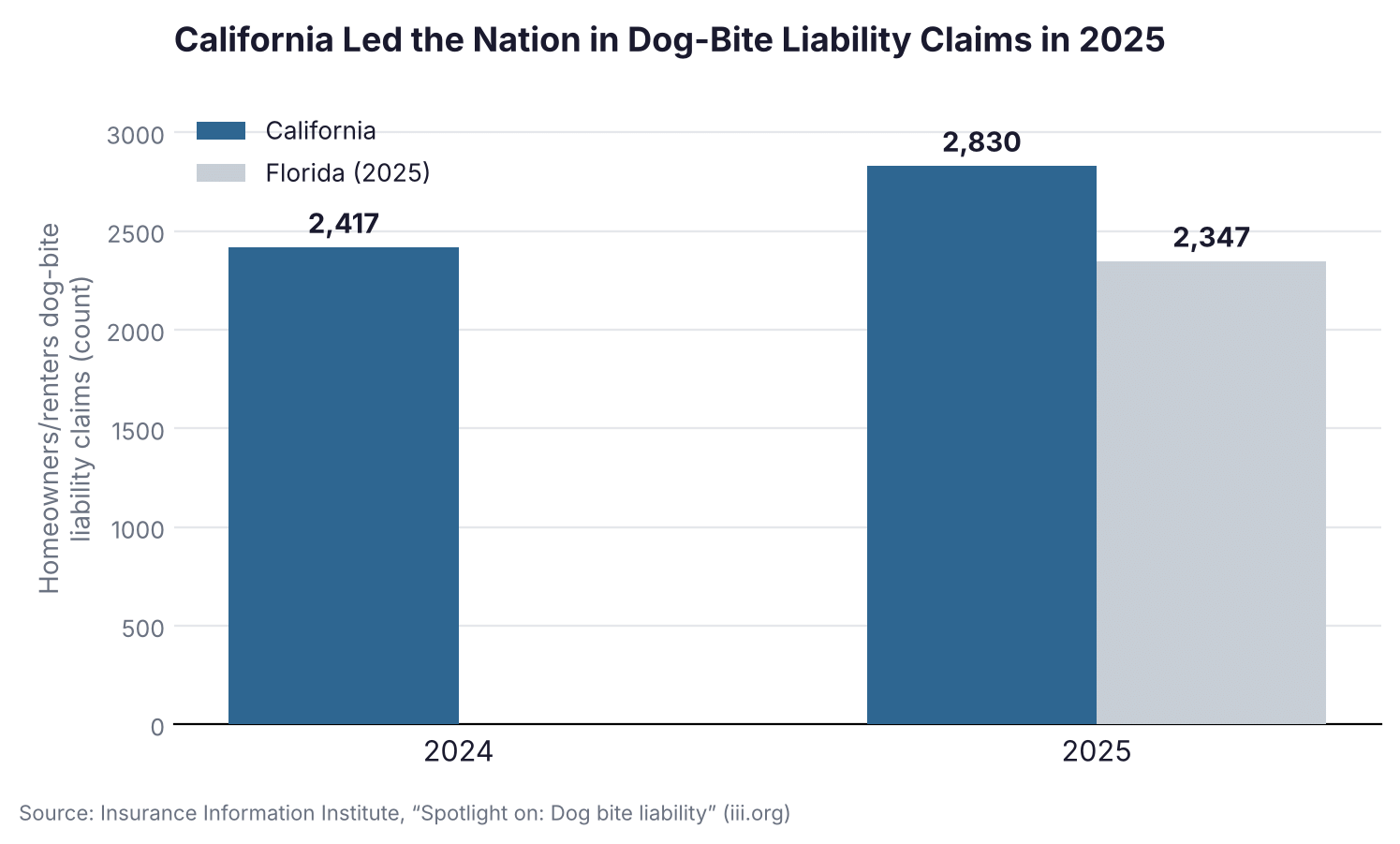
On the insurance side, the Insurance Information Institute reports that homeowners and renters insurers paid out roughly $1.86 billion in dog-bite liability claims nationwide in 2025, up 18.6% from the year before, even as the number of claims grew faster than the average payout per claim. California led every state in 2025 with 2,830 dog-bite liability claims more than any other state in the country and the average California claim cost insurers more than $81,000.
That volume of claims is also why insurance can get complicated fast after a bite which is the next thing to understand before you deal with an adjuster.
Click to contact us today
Insurance After a Dog Bite: What to Expect
Most dog bite claims in California are ultimately paid, if at all, through the dog owner’s homeowners or renters insurance policy. The Insurance Information Institute notes that these policies typically cover dog-bite liability up to limits of roughly $100,000 to $300,000, with the owner personally on the hook for anything above that limit. A few practical realities follow from this:
- Some insurers exclude certain breeds entirely or evaluate coverage case-by-case after a dog has already bitten someone.
- An insurer may raise the owner’s premium, decline to renew the policy, or require the dog be muzzled, caged, or removed from the property after a claim.
- If injuries are serious and exceed the policy limits, the owner’s personal assets may be exposed which is one reason these claims are often contested aggressively by insurance adjusters trying to minimize payouts.
Complete a Free Case Evaluation form now
Comparative Fault: Could Your Own Actions Reduce Your Recovery?
California follows a pure comparative negligence rule, meaning an injured person can still recover damages even if they were partly at fault for the incident for example, if they provoked the dog or ignored a visible “Beware of Dog” sign. Fault is simply apportioned, and your recovery is reduced by your own percentage of responsibility rather than eliminated outright. Insurance adjusters routinely raise provocation or trespassing arguments to try to shift blame onto the victim, which is why documenting exactly what happened including witness accounts and the location of the bite matters early on.
What to Do After a Dog Bite in California
- Seek medical care immediately. Dog bites carry a real infection and nerve-damage risk even when they look minor at first.
- Get the owner’s contact and insurance information, along with proof of the dog’s rabies vaccination status.
- Photograph the injury, the location, and any relevant signage (or lack of warning signs) as soon as possible.
- Identify witnesses and get their contact information before they leave the scene.
- Report the bite to local animal control or law enforcement, which creates an official record of the incident.
- Avoid giving a recorded statement to the owner’s insurer before speaking with an attorney early statements are often used to argue comparative fault.
- Don’t wait to get legal advice. California’s statute of limitations for personal injury claims (Code of Civil Procedure § 335.1) generally gives you two years from the date of the bite to file a lawsuit, but evidence and witness memories fade quickly.
Frequently Asked Questions
Does it matter if the dog has never bitten anyone before?
No. Under Civil Code § 3342, California’s strict liability rule applies “regardless of the former viciousness of the dog or the owner’s knowledge of such viciousness.” A first-time bite is still fully actionable.
What if I was bitten on the dog owner’s property?
You’re still covered if you were lawfully on the property for example, as an invited guest or someone performing a duty like a delivery. The statute does not protect owners just because the bite happened at their home.
What if I was bitten by a police or military dog?
Section 3342 carves out a narrow exception for government dogs used in police or military work under specific conditions and a written agency policy. These cases require a different legal analysis than a typical dog bite claim.
How long do I have to file a claim?
Generally, two years from the date of the bite under California’s personal injury statute of limitations (CCP § 335.1), though claims against a government entity or involving a minor can follow different rules. Don’t wait to find out which applies to you.
Talk to our firm – Zade-Law, APC
Dog bite cases can turn into a fight with an insurance company the moment you report the claim even when California law is squarely on your side. If you or a loved one was bitten by a dog in California, contact Zade-Law, APC today for a free consultation to find out what your claim may be worth and what to do next.
Call or text (310) 424-7858 or complete a Free Case Evaluation form