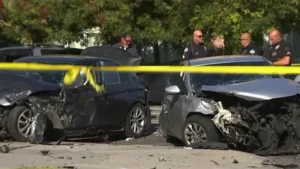
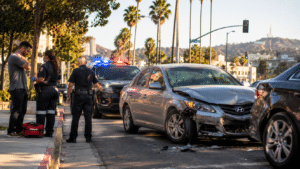
Early this week, Beverly Hills police spotted a Mercedes driving erratically near Santa Monica and Beverly Boulevards. Around the same time, officers located what they believed was a stolen vehicle nearby. As officers moved to make a felony stop, the driver slammed into a police vehicle, then veered off the road, struck a tree, and caught fire. The driver was taken to the hospital in critical but stable condition, and the crash remains under investigation as a possible DUI, according to NBC Los Angeles.
This time, the only person hurt appears to have been the fleeing driver. But incidents like this happen on Los Angeles streets with some regularity, and they don’t always end that way. A stolen or erratic vehicle fleeing from police can just as easily plow through an intersection, strike a parked car with someone inside, or hit a pedestrian on the sidewalk. When that happens, injured bystanders are left facing one of the most legally tangled situations in personal injury law: who, exactly, is responsible for paying their medical bills?
The honest answer is that it depends on several moving parts most people have never had to think about and getting it wrong can mean leaving real compensation on the table or missing a deadline that closes the door on a claim entirely.
Why Police-Chase and Stolen-Vehicle Crashes Are Different
Most car accident claims are straightforward: one driver was negligent, their insurance pays, and the case resolves within that framework. A chase or stolen-vehicle crash involves at least three potential parties with very different legal exposure:
- The fleeing driver, who is almost always liable for ordinary negligence (and often more, if DUI or reckless driving is involved)
- The registered owner of the vehicle, who typically bears no responsibility at all if the car was genuinely stolen
- The law enforcement agency conducting the pursuit, which may or may not be shielded from liability depending on its own policies
Each of those relationships is governed by different rules, and a bystander hurt in the crossfire has to untangle all three to know where real financial recovery might come from.
For a free legal consultation call (310) 424-7858
The Fleeing Driver Is Liable But May Have Nothing
Under California’s pure comparative negligence rule, a driver who flees police and causes a crash is liable for the full extent of harm they cause, reduced only by any percentage of fault that might be assigned to someone else involved. If drugs, alcohol, or a stolen vehicle are involved, that often strengthens a claim for punitive damages on top of compensatory damages.
The practical problem is collectability. A person driving a stolen car during a police pursuit is frequently uninsured, has no meaningful assets, and may be headed to jail rather than to a settlement table. A judgment against someone with no insurance and no assets is often not worth the paper it’s printed on.
This is exactly why uninsured and underinsured motorist (UM/UIM) coverage on your own auto policy matters so much in California. An estimated 20.4% of California drivers carry no insurance at all, one of the highest uninsured-motorist rates of any state, according to Insurance Research Council data cited by the Insurance Information Institute. If you’re a pedestrian, cyclist, or passenger hurt by an uninsured fleeing driver, your own UM coverage not the at-fault driver’s nonexistent policy is frequently the realistic path to compensation. Hit-and-run crashes, which are common in chase scenarios, also typically fall under UM coverage in California, even when the driver is never identified.
Can You Sue the Registered Owner of a Stolen Car?
Generally, no. California imposes liability on vehicle owners under a permissive-use theory meaning an owner can be responsible if they knowingly let someone else drive their car. But if the vehicle was genuinely stolen, the owner didn’t grant permission, and courts have long recognized that a theft victim isn’t liable for what the thief does with the car afterward. This is one reason it matters, early on, to confirm through the police report whether the vehicle was reported stolen versus loaned to the driver.
Click to contact us today
What About Suing the Police Department?
This is the question people ask most often, and the answer surprises most of them: usually, you can’t at least not simply because a pursuit happened.
California Vehicle Code section 17004.7 gives public agencies immunity from liability arising out of a vehicle pursuit, if the agency has adopted and promulgated a written pursuit policy that meets a detailed list of statutory minimum standards, and trains its officers on it annually. Nearly every California law enforcement agency, including most in Los Angeles County, has adopted such a policy specifically to obtain this immunity. In practice, that means an injured bystander generally cannot recover from the police department simply by arguing the chase itself was dangerous or shouldn’t have been pursued.
That immunity isn’t absolute. If an agency lacks a compliant policy, failed to train on it, or an officer’s conduct falls outside ordinary pursuit driving (for example, an officer’s own vehicle directly and independently causes a crash through clear negligence unrelated to the pursuit decision), a claim against a public entity may still be viable. Importantly, any claim against a city, county, or state agency in California pursuit-related or not must first comply with the Government Claims Act, which generally requires filing a formal claim with the public entity within six months of the incident. Miss that window, and a claim against the agency is typically barred regardless of its merits.
Complete a Free Case Evaluation form now
If You’re Hurt in a Chase-Related Crash, Do This
- Call 911 and get medical attention, even if injuries seem minor adrenaline masks pain, and a documented medical record ties your injuries to the incident
- Get the police report number and the names of responding officers from both the pursuing agency and any agency that responds to the crash scene
- Photograph the scene, vehicle damage, and your injuries before anything is moved or repaired
- Identify whether the vehicle was reported stolen this affects who can be sued
- Check your own auto policy for uninsured/underinsured motorist coverage, and report the claim to your own insurer promptly
- If a government agency may be involved, note the date of the incident immediately the six-month Government Claims Act deadline is much shorter than the standard injury statute of limitations
- Avoid giving a recorded statement to any insurance company, including your own, before speaking with an attorney
Know Your Deadlines
Outside of claims against a government entity, California’s general statute of limitations for personal injury claims is two years from the date of the incident, under Code of Civil Procedure section 335.1. That sounds like a long time, but evidence from a fast-moving chase scene skid marks, damaged property, witness memories, even the vehicle itself degrades quickly. And if a public entity is a potential defendant, the real deadline that controls your case is the six-month government claim window, not the two-year statute.
Zade-Law, APC Is Here to Help
If you or someone you love was hurt in a crash involving a fleeing vehicle, a stolen car, or a police pursuit anywhere in the Los Angeles area, you don’t have to untangle California’s liability rules, insurance coverage questions, and government claim deadlines on your own. Zade-Law, APC offers free consultations to help injured Californians understand their options and identify every available path to compensation. Reach out to our office today to discuss your situation with our team.
Call or text (310) 424-7858 or complete a Free Case Evaluation form