Los Angeles drivers got a rough reminder this weekend of how quickly a normal freeway commute can turn into a multi-vehicle catastrophe. In the span of about 19 hours, two separate chain-reaction crashes shut down major Los Angeles freeways one fatal, one leaving seven people hurt, including children evaluated at the scene.
If you’ve ever been in or worried about being in a pileup like these, this post walks through exactly what to do (and what not to do) in the minutes, days, and weeks after a multi-car freeway crash in California, and why these crashes are legally messier than a simple two-car fender-bender.
What Happened on the 5 and the 405
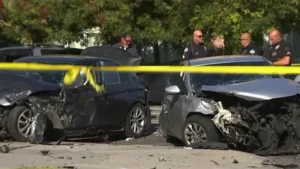
Just after midnight on Sunday, November 1, a deadly crash involving at least three vehicles one of which overturned shut down all northbound lanes of the 405 Freeway in Sherman Oaks, near the interchange with the 101. One person died. The California Highway Patrol said details about what caused the collision were not yet available, and ABC7 Los Angeles reported the lanes didn’t fully reopen until nearly 7 a.m.
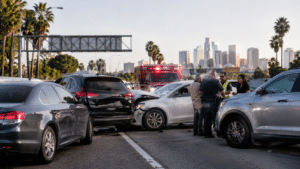
Later that same night, a separate crash involving at least five vehicles injured seven people on the southbound 5 Freeway near Dodger Stadium. The LA Fire Department said one person was seriously hurt and six others suffered minor injuries, with no extrications needed. Aerial news footage showed several children being evaluated by paramedics at the scene, according to ABC7’s report on the crash.
Two unrelated pileups, two different freeways, the same weekend. Neither is unusual for Los Angeles multi-vehicle freeway crashes happen with some regularity on the 5, the 405, and the rest of the region’s congested corridors. What is worth paying attention to is just how complicated these crashes get once the tow trucks leave and the insurance calls start.
For a free legal consultation call (310) 424-7858
Why Chain-Reaction Crashes Are Legally Complicated
A simple rear-end crash between two cars is usually straightforward: one driver is following too closely, and California law already leans toward presuming that driver is at fault. A five-car pileup is a different animal entirely.
When a chain-reaction crash happens, investigators and insurers have to untangle a sequence: Who braked first, and why? Did a driver in the middle of the chain get hit from behind and pushed into the car in front of them meaning they may not be at fault at all for that impact, even though their car caused damage to someone else? Was a vehicle already stopped or slowed by an earlier, unrelated event? Multiple insurance companies, each representing a different driver, often end up pointing fingers at each other’s policyholders, which can leave an injured passenger or driver stuck in the middle while the carriers fight it out.
This is exactly where California’s comparative fault rules matter. The state follows a pure comparative negligence system, meaning that even if you’re found partially at fault for a crash, you can still recover damages just reduced by your percentage of responsibility. In a multi-car pileup, that percentage is rarely obvious, and insurers have every incentive to push as much fault onto you as they can get away with, since every point of fault assigned to you is a point they don’t have to pay.
When a crash involves several defendants, California’s Proposition 51 generally limits each driver’s liability for non-economic damages things like pain and suffering to their own share of fault, while economic damages like medical bills and lost wages typically remain subject to joint liability among at-fault parties. In practice, that means your compensation can come from more than one driver’s insurance policy, but how much each one owes depends on a fault allocation that may take weeks or months to sort out.
What to Do Immediately After a Multi-Car Freeway Crash
If you’re involved in or hurt in a chain-reaction crash on an LA freeway, a few steps in the first hours and days can make a real difference to your health and your claim:
- Call 911 and get medical attention, even if you feel fine. Adrenaline masks pain, and some serious injuries (whiplash, concussion, internal injuries) don’t show symptoms right away.
- Document everything at the scene if you’re able to safely do so photos of all vehicles involved, final resting positions, skid marks, road conditions, and any visible injuries.
- Get the CHP incident or report number and the badge numbers of responding officers. In a multi-car crash, the official report’s description of the sequence of impacts often becomes the single most important piece of evidence.
- Collect contact information for every driver and witness, not just the car directly in front of or behind you in a five-car pileup there may be witnesses who saw the whole sequence unfold.
- Notify your own insurance company, but be cautious about giving detailed recorded statements to any other driver’s insurer before you understand how fault is likely to be allocated.
- Keep a written timeline and symptom log in the days after the crash, since injuries and memories of the sequence of events can both evolve.
Click to contact us today
What Not to Do
- Don’t assume you’re at fault just because your car hit the vehicle in front of you in a chain-reaction crash, you may have been pushed forward by the impact behind you.
- Don’t accept a quick settlement offer from any insurance company before you’ve been medically evaluated and understand the full scope of your injuries.
- Don’t discuss fault, apologize, or speculate about “what happened” with other drivers at the scene let the investigation and evidence establish the sequence of events.
- Don’t wait to seek legal guidance if multiple vehicles and multiple insurers are involved these cases often require piecing together evidence from several sources before a fair settlement is possible.
Complete a Free Case Evaluation form now
Deadlines You Still Need to Watch
Regardless of how many vehicles were involved, California’s standard personal injury statute of limitations still applies generally, two years from the date of the crash to file a lawsuit, under Code of Civil Procedure section 335.1. If a government vehicle or public roadway defect contributed to the crash for example, a malfunctioning freeway signal or an on-duty government vehicle the California Government Claims Act requires a formal claim against that public entity within just six months, a far shorter window that catches many injured drivers off guard.
If You Were Hurt in a Multi-Vehicle Crash
Chain-reaction freeway crashes like this weekend’s incidents on the 5 and the 405 often take longer to sort out precisely because more parties, more insurers, and more conflicting accounts are involved. That complexity is exactly when it helps to have someone building your case while the evidence the CHP report, witness statements, dashcam and traffic camera footage, medical records is still fresh and available.
If you or someone you love was injured in a multi-car crash in Los Angeles, Zadelaw offers a free consultation to review what happened, explain your options, and help make sure fault gets allocated fairly instead of just convenient for the insurance companies involved. Reach out today to discuss your situation.
Call or text (310) 424-7858 or complete a Free Case Evaluation form