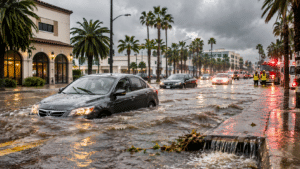
A fast-moving storm turned freeways into rivers this week. Here’s how California law treats injuries, rescues, and property damage caused by flash flooding and what to do if it happened to you.
A Storm That Hit Los Angeles Hard
Overnight on November 18 into the morning of November 19, 2026, an atmospheric river pushed through Southern California on the heels of flooding that had already shut down streets in the San Francisco Bay Area the day before. In Los Angeles County, the National Weather Service issued flash flood warnings covering Glendale, Santa Clarita, and Burbank, along with a severe thunderstorm warning for much of the county and winds gusting near 60 mph. Rainfall rates peaked at an “impressive” 2.26 inches per hour in Sepulveda Canyon, and Los Angeles County Fire issued an evacuation warning for the Palisades, Hurst, and Sunset burn scar areas due to possible debris flows.
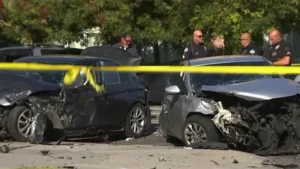
The storm wasn’t just an inconvenience. On Firestone Boulevard in South Gate, a car hydroplaned on the wet roadway and struck a light pole; firefighters had to use the Jaws of Life to free the trapped driver, who was taken to the hospital. Across the San Fernando Valley and San Gabriel Valley, Los Angeles Fire Department and Los Angeles County Fire crews ran a string of swift-water rescues within a few hours of each other on November 19: a woman was short-hauled by helicopter out of the Los Angeles River channel near Encino Golf Course; seven cars some with people still inside were found stuck in deep water on Vineland Boulevard between Vanowen Street and Sherman Way; and a swift-water team pulled five people from the San Gabriel River near South El Monte, at least two of them by helicopter, as local outlets reported.
Flooding doesn’t always come from the sky, either. A reminder of that arrived earlier this year when a 36-inch LADWP trunk main failed under Sunset Boulevard in West Hollywood, opening a sinkhole and sending water into a restaurant, apartment garages, and a Metro bus yard submerging roughly two dozen cars in one parking structure alone, according to CBS Los Angeles. No one was hurt in that incident, but it illustrates a second category of flood-related harm Southern Californians regularly face: infrastructure failures, not just storms, and the question of who is legally responsible when they cause injury or loss.
And the pattern isn’t confined to Los Angeles. The same system that soaked the Bay Area the day before, per ABC News, flooded streets so badly that storm drains backed up and trees came down, and it prompted Waymo to pause its rob taxi service for the duration a reminder that even sophisticated driving systems treat flash flooding as a serious hazard.
For a free legal consultation call (310) 424-7858
The Injuries That Follow a Flash Flood
In our experience, flood and heavy-rain events in Southern California tend to produce a recognizable set of injury claims:
- Hydroplaning and weather-related collisions vehicles that lose traction on standing water, as in the South Gate crash, often at speeds that were legal in dry conditions but unsafe in the rain.
- Swift-water rescue injuries people trapped in vehicles, storm channels, or the Los Angeles River who are injured while being swept by current, extricated, or air-lifted to safety.
- Slip-and-fall and premises injuries falls on flooded sidewalks, stairwells, parking structures, or building entries where water, mud, or debris accumulated.
- Debris flow and mudslide injuries harm from material moving off burn-scarred hillsides onto roads, driveways, or homes below evacuation-warning zones.
- Infrastructure-failure injuries harm or property loss from a burst water main, failed storm drain, or overwhelmed public drainage system, as opposed to rainfall itself.
Weather Is Not a Legal Excuse
A common misconception is that a crash or fall “caused by the rain” has no at-fault party. California law doesn’t see it that way. Drivers have an ongoing duty to adjust their speed and following distance to road conditions California’s basic speed law makes it unlawful to drive at a speed that is unsafe for conditions, even when that speed is under the posted limit. A driver who hydroplanes because they were going too fast for a flooded roadway can still be found negligent.
California is a pure comparative negligence state, which matters a great deal in storm-related cases where both sides often share some responsibility. Under this rule, an injured person’s damages are reduced by their own percentage of fault, but they are not barred from recovering entirely, even if they were found, say, 40% or 60% responsible. And where more than one party contributed to the harm a speeding driver and a city that let a drain clog, for instance Proposition 51 generally makes each defendant liable only for their own share of non-economic damages (pain and suffering), while economic damages such as medical bills typically remain joint and several.
Click to contact us today
Property Owners, Landlords, and Businesses Have Duties Too
When flooding reaches a parking garage, apartment complex, or storefront, the property owner or manager’s responsibility doesn’t disappear just because the water came from outside. California premises liability law requires owners and managers to act reasonably to protect people on their property clearing or barricading hazardous flooded areas, posting warnings, maintaining drainage and sump systems, and responding promptly once a flooding hazard is known. A tenant hurt wading through a flooded garage that management knew about and did nothing to address, or a customer who slips in water tracked through a poorly maintained entryway, may have a viable premises liability claim independent of any driving negligence.
Complete a Free Case Evaluation form now
When a Government Agency Is Involved, the Clock Moves Fast
Many flood-related incidents point back to a public entity: a county flood-control channel, a city storm drain, a state highway, or as with the West Hollywood water main a municipal utility like the Los Angeles Department of Water and Power. Claims against California cities, counties, and public agencies are governed by the Government Claims Act, which generally requires a formal administrative claim to be filed with the agency within just six months of the injury far shorter than the two-year window most people assume they have. Miss that deadline, in most cases, and the right to sue the public entity is lost no matter how strong the underlying case is. This is one of the single most common and avoidable ways a legitimate flood-injury claim gets cut off before it starts.
By contrast, an ordinary negligence claim against a private driver, landlord, or business in California generally must be filed within two years of the injury under Code of Civil Procedure section 335.1. The two timelines run independently, and a single flooding incident can easily involve both a private driver and a public agency which is exactly why the deadline question should be sorted out early, not after the fact.
What To Do If You’re Hurt in a Flood-Related Incident
- Get medical care first. Cold-water immersion, impact injuries, and even minor collisions can mask symptoms that worsen over the following days.
- Make sure the incident is officially documented. Ask for the police report number, fire department incident number, or rescue log if one exists these records matter later.
- Photograph the conditions, not just the damage. Standing water depth, missing barricades, absent warning signs, and road or drain conditions are often gone within hours.
- Never enter moving floodwater, a flood channel, or the Los Angeles River to retrieve a vehicle or belongings this is how many swift-water rescues begin.
- Notify your landlord or the property owner in writing if flooding on their property caused the harm and keep a copy of that notice.
- Identify whether a public entity may be involved (a city street, county channel, or public utility) as early as possible the six-month Government Claims Act deadline does not wait for you to feel ready.
- Keep records of lost wages and out-of-pocket costs tied to the incident, including towing, rideshare costs, and property damage.
- Talk to a lawyer before accepting any insurance settlement, particularly where a government agency, utility, or multiple drivers may share fault.
The Bottom Line
Flash floods, debris flows, and water-main failures are environmental events, but the injuries and losses they cause are still evaluated the same way any other injury claim is: Was there negligence? Who had a duty to act, and did they meet it? And was the claim brought in time? The deadlines are what trip people up most especially the six-month window for claims against public agencies so the most useful thing an injured person can do in the first few days is get medical care, document what happened, and find out quickly whether a public entity is in the mix.
If you or someone you love was injured in this week’s storm, a swift-water rescue, a flooded property, or a water-main failure anywhere in California, Zade-Law, APC is available for a free consultation to help you understand your options and protect your deadlines.
— Zade-Law, APC
Sources
- “Los Angeles rain, evacuation warnings issued for Southern California burn scar areas ahead of storm,” ABC7 Los Angeles (KABC), updated Nov. 19, 2026
- “Heavy rain, flooding shut down San Francisco Bay Area streets,” ABC News, Nov. 18, 2026
- “Fire crews rescue Californians trapped in vehicles amid flash flooding,” California Post / Yahoo News, Nov. 19–20, 2026
- “Los Angeles-area water main break floods West Hollywood streets, causes sinkhole,” CBS Los Angeles, July 16, 2026
Disclaimer
This article is attorney advertising and is provided for general informational purposes only. It does not constitute legal advice and does not create an attorney-client relationship between Zade-Law, APC and any reader. Laws referenced here, including statutes of limitations and government claims deadlines, change over time and can apply differently depending on the specific facts of a case, so nothing in this post should be relied upon as a substitute for individualized legal advice. Prior results do not guarantee a similar outcome. If you believe you have a legal claim, you should consult a licensed California attorney promptly, as strict deadlines may apply.
Call or text (310) 424-7858 or complete a Free Case Evaluation form