Motorcycle accident claims face a problem car accident claims generally don’t: built-in bias. Adjusters, juries, and even witnesses often start from the assumption that a motorcyclist was speeding, weaving, or “asking for it” regardless of what the evidence actually shows. Insurance companies know this bias exists, and some of the most common tactics in motorcycle claims are built specifically to exploit it.
The Numbers Behind the Bias
Motorcyclists face a genuinely higher risk on the road than other drivers, and insurers use that statistical reality to justify an unfair starting assumption. According to Insurance Information Institute data drawn from NHTSA, motorcyclists were killed at a rate of 31.39 per 100 million vehicle miles traveled in 2023, compared to just 1.13 for passenger cars and 0.66 for light trucks meaning a mile on a motorcycle is roughly 28 times more likely to end in a fatality than the same mile in a passenger car.
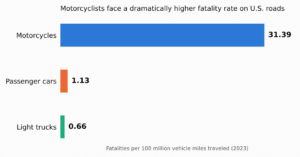
2023 NHTSA data via the Insurance Information Institute. (Original chart created for this article from publicly cited statistics.)
That risk is real, and it’s driven mostly by physics a motorcyclist has none of the structural protection a car provides. But insurers frequently use these same numbers to frame motorcyclists generally as reckless, rather than as a road user category that is simply more vulnerable to the same kinds of negligent driving that cause any crash. That framing shows up directly in how claims get handled.
For a free legal consultation call (310) 424-7858
Tactic #1: Blaming Legal Lane Splitting as “Reckless”
California is one of the only states where lane splitting riding between rows of stopped or slow-moving traffic in the same lane is explicitly legal. Under California Vehicle Code § 21658.1, the California Highway Patrol is authorized to publish educational guidelines on lane splitting, developed in consultation with the DMV, Caltrans, the Office of Traffic Safety, and a motorcycle safety organization, specifically to protect both motorcyclists and nearby drivers.
Despite that, insurance adjusters and sometimes jurors often treat the mere fact that a rider was lane splitting as evidence of recklessness, even when the rider was traveling at a safe speed differential and splitting in a reasonable location. Because California follows pure comparative negligence, successfully pushing this narrative doesn’t need to defeat your claim entirely it only needs to shave fault percentage points off your recovery, which is often exactly the goal.
Tactic #2: Using the Helmet Law Against You
California requires both motorcycle operators and passengers to wear a DOT-compliant helmet, properly fastened, under Vehicle Code § 27803. When a rider wasn’t wearing a compliant helmet, or the helmet wasn’t properly secured, insurers will often argue that this contributed to the severity of head or facial injuries sometimes even when the type of injury wouldn’t have been meaningfully affected by helmet use at all.
This argument is used both fairly and unfairly. Where a genuine helmet-related causation issue exists, it can validly reduce a claim’s value under comparative negligence. But adjusters frequently raise it reflexively, as a negotiating anchor, in cases where the injury mechanism (a fractured limb, internal injuries, road rash) had nothing to do with helmet use at all.
Click to contact us today
Tactic #3: “The Bike Barely Has a Scratch”
One of the most common lowball tactics in motorcycle claims exploits a simple visual mismatch: unlike cars, motorcycles don’t have crumple zones or large body panels that visibly absorb and display crash energy. A relatively low-speed impact that leaves minimal cosmetic damage to the motorcycle can still throw the rider’s body directly into pavement, a vehicle, or a guardrail, with catastrophic consequences.
Adjusters know that photos of lightly damaged motorcycles make for a persuasive visual argument to a claims supervisor or, eventually, a jury even when it has no real relationship to the forces the rider’s body actually absorbed. Independent biomechanical or accident reconstruction analysis is often necessary to counter this specific argument in more serious cases.
Complete a Free Case Evaluation form now
Other Common Lowball Tactics in Motorcycle Claims
- Fast, early settlement offers made before the full extent of orthopedic or neurological injuries is diagnosed common with road rash and soft-tissue injuries that mask more serious underlying damage
- “Failure to see” framing, where the at-fault driver’s own failure to notice a motorcycle before turning or merging gets reframed as the motorcyclist’s failure to be “more visible”
- Disputing the medical necessity of extended treatment, physical therapy, or orthopedic surgery, particularly for injuries that aren’t visible on a single X-ray
- Using a rider’s social media (track day photos, stunts, other riding content) out of context to suggest a general pattern of recklessness unrelated to the actual crash
- Delay tactics intended to pressure an injured rider often facing lost wages and mounting medical bills into accepting an early, inadequate offer
What Strengthens a California Motorcycle Claim
- Photographing the full accident scene, lane position, and both vehicles immediately, not just the motorcycle’s visible damage
- Getting independent medical evaluation and imaging promptly, even if injuries initially seem minor
- Documenting helmet and gear compliance if relevant, including showing the helmet met DOT standards
- Identifying independent witnesses, since motorcyclists are disproportionately blamed by default in “he-said-she-said” disputes
- Requesting any available dash-cam, traffic camera, or surveillance footage from nearby businesses before it’s deleted
- Avoiding early recorded statements or quick settlement offers before a full medical picture is established
Bottom Line
Motorcycle accident claims carry a built-in credibility battle that other injury claims don’t face to the same degree. Recognizing the specific tactics insurers use, lane-splitting framing, helmet arguments, and the “minimal bike damage” narrative is often the first step in making sure a claim is evaluated on the actual facts rather than a stereotype.
If you’ve been injured in a motorcycle accident in California, Zadelaw offers free consultations to help counter unfair bias in your claim and pursue the full compensation you’re entitled to. Contact Zadelaw today to discuss your case.
Call or text (310) 424-7858 or complete a Free Case Evaluation form