

Getting hit by, or while riding in, an Uber or Lyft creates a legal puzzle that a normal car accident doesn’t: which insurance policy applies depends on what the driver’s app was doing at the exact moment of the crash. California law sets up three very different coverage tiers for the same driver, on the same day, in the same car and the gap between them is enormous. Here’s how it works, and what it means for your claim.
The Three Insurance Periods, and Why They Matter
California’s Transportation Network Company law, codified at Public Utilities Code § 5433, requires companies like Uber and Lyft to carry different levels of insurance depending on the driver’s app status. Rideshare companies break this into three periods, and Uber’s own insurance overview confirms how it applies them in practice:
- Period 0 App off: The driver is off-duty. Only their personal auto insurance applies, at ordinary state minimum limits. The rideshare company provides no coverage at all during this period.
- Period 1 App on, waiting for a match: The driver is logged in and available but hasn’t accepted a ride. Under Section 5433, coverage drops to a minimum of $50,000 per person / $100,000 per accident for injuries and $30,000 for property damage — and that coverage from the TNC only kicks in if the driver’s own personal policy has lapsed or doesn’t apply.
- Period 2 During a trip: Once a ride is accepted, and continuing until the rider is dropped off, Section 5433 requires at least $1,000,000 in combined liability coverage, plus separate uninsured/underinsured motorist coverage of $60,000 per person and $300,000 per incident while a paying passenger is in the vehicle.
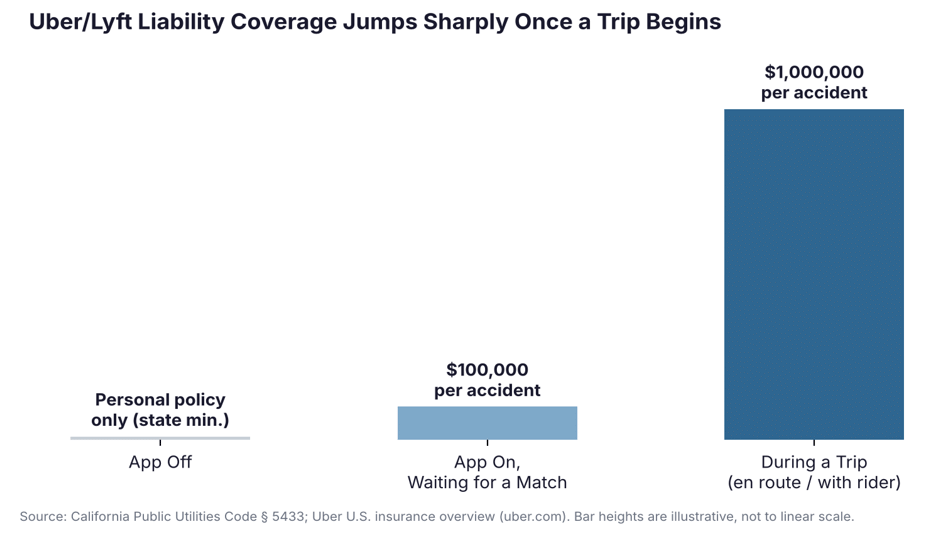
That jump from $100,000 to $1,000,000 the instant a trip begins is exactly why establishing the driver’s app status at the moment of the crash is often the single most important fact in a rideshare injury case.
For a free legal consultation call (310) 424-7858
Who You May Be Able to Pursue a Claim Against
Depending on how the crash happened, a rideshare accident claim can involve several different parties:
- The rideshare driver’s personal auto insurer: especially relevant if the app was off or only just turned on.
- Uber or Lyft’s commercial policy: triggered once the driver is logged in, and significantly larger once a trip is underway.
- A third-party driver: if another motorist caused the crash, their own liability insurance is still the starting point regardless of rideshare status.
- The rideshare company itself: in limited circumstances involving negligent driver vetting or a failure to follow the safety screening required by the CPUC.
California’s Regulatory Role
Rideshare companies operate in California under permits issued by the California Public Utilities Commission, which regulates Transportation Network Companies and requires them to run DMV background checks on drivers, maintain a zero-tolerance policy for safety violations, and meet minimum insurance standards the same standards that create the three coverage tiers above. A documented violation of these CPUC-mandated driver-screening or safety requirements can sometimes support a direct negligence claim against the company, separate from the insurance-coverage question.
Click to contact us today
Comparative Fault Still Applies
California’s pure comparative negligence rule applies to rideshare accidents just as it would to any other car accident: an injured rider or driver can still recover damages even if they were partly at fault, with the award simply reduced by their own percentage of responsibility. Where more than one driver is at fault for example, the rideshare driver and a third-party motorist both contributed to the crash Proposition 51 limits each defendant’s share of non-economic damages (like pain and suffering) to their own percentage of fault, even though economic damages such as medical bills are generally recoverable in full of any at-fault party.
Complete a Free Case Evaluation form now
Why These Claims Get Complicated Fast
- Uber and Lyft’s insurers often assign their own adjusters and defense counsel quickly and may dispute exactly when the trip “began” or “ended” to try to shift the claim into a lower coverage tier.
- App data trip logs, GPS timestamps, and driver status records is often the single most important piece of evidence, and it is controlled entirely by the rideshare company.
- Multiple insurers (the driver’s personal carrier, the TNC’s primary policy, and any third-party driver’s insurer) may all point fingers at each other before anyone pays a claim.
What to Do After a Rideshare Accident
- Get medical attention and document all injuries, even ones that seem minor at first.
- Take a screenshot of your trip details in the app immediately the trip receipt, driver information, and timestamps can disappear from easy view later.
- Report the accident within the app using Uber’s or Lyft’s in-app incident reporting feature, which creates a company record of the crash.
- Get the other driver’s information and photograph the scene, vehicles, and any visible injuries.
- Avoid giving a recorded statement to any insurer the driver’s, the rideshare companies, or a third party’s before speaking with an attorney.
- Act within California’s statute of limitations. Personal injury claims generally must be filed within two years under Code of Civil Procedure § 335.1, though identifying the correct insurer and coverage tier can take time, so don’t wait to get advice.
Frequently Asked Questions
What if the Uber or Lyft driver was logged in but hadn’t accepted a ride yet?
That’s Period 1 coverage: up to $50,000 per person / $100,000 per accident under Public Utilities Code § 5433, and it applies only as a backstop if the driver’s own personal insurance doesn’t cover the loss.
Am I covered as a passenger if the driver causes the crash?
Yes. During an active trip, the rideshare company’s $1,000,000 liability policy applies to injuries to riders and third parties if the driver is at fault.
What if I was hit by an Uber driver while I was a pedestrian or in another car?
The same three-tier system applies based on the Uber or Lyft driver’s app status at the time of the crash, regardless of whether you were a passenger, another driver, or a pedestrian.
How long do I have to file a claim?
Generally, two years from the date of the crash under California’s personal injury statute of limitations (CCP § 335.1). Claims involving a government vehicle or a minor can follow different rules.
Talk to Zade-Law, APC
Figuring out which insurance policy applies to a rideshare accident — and getting that insurer to pay a fair claim is rarely simple. If you were injured in an Uber, Lyft, or other rideshare accident in California, contact Zade-Law, APC today for a free consultation to find out what your claim may be worth and what to do next.
Call or text (310) 424-7858 or complete a Free Case Evaluation form