

After a rideshare accident, the natural instinct is to go after Uber or Lyft directly they’re the company whose app put the driver on the road. But in California, that’s usually not how these claims work. Rideshare drivers are classified as independent contractors, not employees, which means your claim is almost always directed at an insurance policy rather than the company’s own assets and which policy applies depends on a detail many people overlook: exactly what the driver’s app was doing at the moment of the crash.
Why You (Usually) Can’t Sue Uber or Lyft Directly
Under California’s legal framework for rideshare companies which, according to Wikipedia’s overview of transportation network company regulation, dates back to 2013, when California became the first state to regulate ridesharing under the California Public Utilities Commission drivers are classified as independent contractors rather than employees. That classification was reinforced in 2020 when California voters approved Proposition 22, exempting rideshare companies from the stricter employee-classification test imposed by Assembly Bill 5.
Because the driver isn’t legally an employee, the traditional doctrine that makes an employer liable for an employee’s on-the-job conduct (respondent superior) generally doesn’t apply the way it would with, say, a delivery company’s own employee-driver. That’s precisely why California lawmakers built a mandatory insurance structure directly into rideshare regulation so injured people have a real source of recovery even without being able to sue the company itself.
For a free legal consultation call (310) 424-7858
California’s Three-Period Insurance Framework
Under California Public Utilities Code § 5433, the insurance that applies to a rideshare accident depends entirely on what the driver’s app was doing when the crash happened:
- App off: The driver isn’t logged into the rideshare app at all. Only the driver’s personal auto insurance applies the rideshare company’s coverage doesn’t attach.
- Period 1 app on, waiting for a ride request: The TNC must provide at least $50,000 per person / $100,000 per incident for death and injury, plus $30,000 for property damage, along with at least $200,000 in excess coverage.
- Periods 2 & 3 en route to pick up a passenger through drop-off: Coverage jumps dramatically, to a $1,000,000 primary policy for death, injury, and property damage, plus mandatory uninsured/underinsured motorist coverage of $60,000 per person and $300,000 per incident while a passenger is in the vehicle.
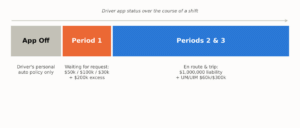 California’s three insurance periods under Public Utilities Code § 5433. (Original graphic created for this article.)
Critically, the statute also makes clear that this coverage doesn’t depend on a driver’s personal auto insurer denying the claim first if the driver’s rideshare-specific policy has lapsed, the company must still cover the claim from the first dollar.
Why the Coverage Period Becomes a Real Fight
Because the applicable coverage amount can swing from $100,000 to $1,000,000 depending on the driver’s app status at the exact moment of the crash, insurers frequently dispute which period applies, especially in the narrow window right after a ride ends or right before a request is accepted. A driver who has just dropped off a passenger and claims to have “just closed the app” when the crash happened can become the center of a serious coverage dispute between the rideshare company’s insurer and the driver’s personal insurer.
This is one of the main reasons that preserving the trip data from the rideshare app timestamps for ride acceptance, pickup, and drop-off is often just as important as the police report itself.
Click to contact us today
Who Can Be Liable Depending on Your Role in the Accident
- Rideshare passenger injured by the driver’s own negligence or by another vehicle: generally covered by the rideshare company’s Period 2/3 policy.
- Rideshare driver injured by another motorist while logged into the app: may have access to both the at-fault driver’s liability coverage and the rideshare company’s uninsured/underinsured motorist coverage, depending on the period.
- Pedestrian, cyclist, or another motorist hit by a rideshare driver: the applicable rideshare insurance period still determines which policy and coverage limit apply, even though the injured person was never a passenger.
- Accidents involving more than one driver: when a rideshare vehicle is one of several negligent parties, California’s several-liability rules under Proposition 51 can also come into play for dividing non-economic damages among the defendants.
Complete a Free Case Evaluation form now
Practical Steps After a Rideshare Accident
- Take a screenshot of the trip details in the app (driver info, trip status, timestamps) before the record becomes harder to access
- Request a copy of the trip receipt and any in-app accident report confirmation
- Call the police and get an official collision report, which will also help establish the timeline
- Photograph the vehicles, the scene, and any visible injuries
- Seek prompt medical attention and keep records tying your injuries to the crash
- Avoid giving a recorded statement to any insurer the driver’s, the rideshare company’s, or another driver’s before understanding which coverage period applies to your claim
Regulatory Oversight
Rideshare companies operating in California are licensed and regulated by the California Public Utilities Commission, which oversees TNC permitting, driver background check requirements, and insurance compliance. Enforcement details and specific insurance filings for a given company are part of the public regulatory record the CPUC maintains.
Bottom Line
A rideshare accident claim in California isn’t really a claim against Uber or Lyft as a company it’s a claim against a layered insurance structure that changes based on exactly what the driver’s app was doing at the moment of the crash. Identifying the correct coverage period early, and preserving the app data that proves it, is often the single biggest factor in what a rideshare accident claim is actually worth.
If you’ve been injured in a rideshare accident in California as a passenger, a driver, or someone else on the road, Zadelaw offers free consultations to help identify the applicable insurance coverage and pursue the compensation you’re owed. Contact Zadelaw today to discuss your case.
Call or text (310) 424-7858 or complete a Free Case Evaluation form