
Falling on someone else’s property doesn’t automatically mean they owe you money. California slips and falls cases are won or lost on a single question: did the property owner know or should they have known about the dangerous condition in time to fix it or warn you? Here’s what you must prove, and why insurance companies fight these cases so hard.
The Legal Standard: Ordinary Care, Not Perfection
California property owners owe visitors a duty of ordinary care under Civil Code section 1714, which makes a person responsible for harm caused by “want of ordinary care or skill in the management of his or her property.” California takes a broader approach than many states: rather than treating visitors differently depending on whether they were a guest, a customer, or had no permission to be there, California courts apply a single, unified standard of reasonable care owed to lawful visitors on the property a framework the California Supreme Court set out in the landmark case Rowland v. Christian back in 1968, and one that California premises liability law still follows today. That doesn’t mean property owners are insurers of absolute safety it means they must act as a reasonably careful person would under the circumstances.
For a free legal consultation call (310) 424-7858
The Element That Actually Decides These Cases: Notice
To win a California slip and fall claim, you generally need to show four things: the property owner owed you a duty of care, they breached that duty, the breach caused your fall, and you suffered real damages. In practice, almost every contested case comes down to the second element breach and specifically to a concept called notice. A property owner (or the business, HOA, or government agency managing the property) is typically only liable if:
- Actual notice: An employee or the owner knew about the hazard (a spill, a broken step, a loose rug) and failed to fix it or warn visitors.
- Constructive notice: The hazard existed long enough that a reasonably careful owner conducting routine inspections should have discovered and addressed it.
This is exactly why insurance adjusters immediately ask how long the hazard was there before you fell. A puddle that formed thirty seconds before your fall is a very different case than one that had been sitting there, unaddressed, for two hours and surveillance footage, maintenance logs, and incident reports are often the deciding evidence.
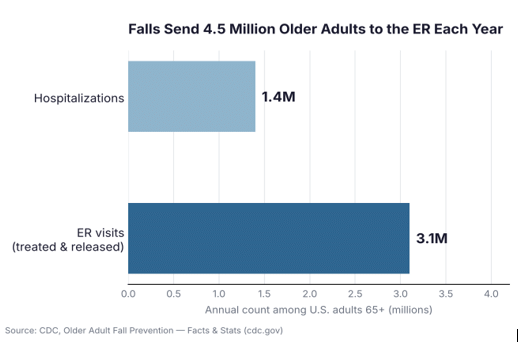
Falls aren’t a minor inconvenience they’re one of the leading causes of serious injury nationwide, which is exactly why these claims are worth taking seriously.
Who Can Be Held Responsible
- Business owners and property managers: for hazards like wet floors, uneven flooring, poor lighting, or obstructed walkways.
- Landlords: for dangerous conditions in common areas of an apartment or rental property, such as broken stairs or inadequate railings.
- Homeowners: typically covered through a homeowners or renters insurance policy for a guest injured on their property.
- Government entities: for hazards on public sidewalks, in government buildings, or on other public property, subject to California’s Government Claims Act, which requires a claim to be presented within six months of the fall (Gov. Code § 911.2) far shorter than the ordinary two-year window.
Click to contact us today
Comparative Fault and Common Insurance Tactics
California’s pure comparative negligence rule means you can still recover damages even if you were partly responsible for your own fall for example, if you were looking at your phone instead of an obviously marked hazard. Your recovery is simply reduced by your percentage of fault rather than eliminated. Knowing this, insurance adjusters frequently argue that the hazard was “open and obvious,” that warning signs were posted, or that the victim wasn’t paying attention, to shift blame and reduce or deny the payout.
Complete a Free Case Evaluation form now
What to Do After a Slip and Fall in California
- Report the fall immediately to the property owner, manager, or employee, and get a copy of any incident report.
- Photograph the hazard exactly as it was the wet floor, the broken step, the lack of a warning sign before it can be cleaned up or repaired.
- Identify witnesses who saw the fall or can speak to how long the hazard had been there.
- Seek medical care promptly even if you feel fine some injuries, especially head and back injuries, don’t show symptoms right away.
- Preserve your clothing and shoes worn during the fall; they can become evidence.
- Don’t sign anything or give a recorded statement to the property owner’s insurer before speaking with an attorney.
- Act quickly. California’s personal injury statute of limitations (CCP § 335.1) generally allows two years, but a fall on government property cuts that window to a six-month claim deadline.
Frequently Asked Questions
Do I need to prove the owner knew about the hazard?
Not always directly you can show either that they knew (actual notice) or that the hazard existed long enough that a reasonably careful owner should have discovered it (constructive notice).
What if there was a warning sign?
A warning sign can reduce liability but doesn’t automatically defeat a claim, especially if the hazard was more dangerous than the sign suggested or the sign wasn’t clearly visible.
Can I still recover damages if I wasn’t watching where I was going?
Likely yes, at least in part. California’s pure comparative negligence rule reduces your recovery by your share of fault rather than barring it entirely.
What if I fell on a public sidewalk?
Claims against a government entity are subject to the Government Claims Act’s six-month claim-filing deadline, which is much shorter than the standard two-year statute of limitations don’t wait to get advice.
Talk to Zade-Law, APC
Proving notice is the hardest part of a California slip and fall claim, and insurance companies know it which is why they move fast to clean up hazards and lock in favorable witness statements. If you were injured in a fall on someone else’s property in California, contact Zade-Law, APC today for a free consultation to find out what your claim may be worth and what to do next.
Call or text (310) 424-7858 or complete a Free Case Evaluation form